
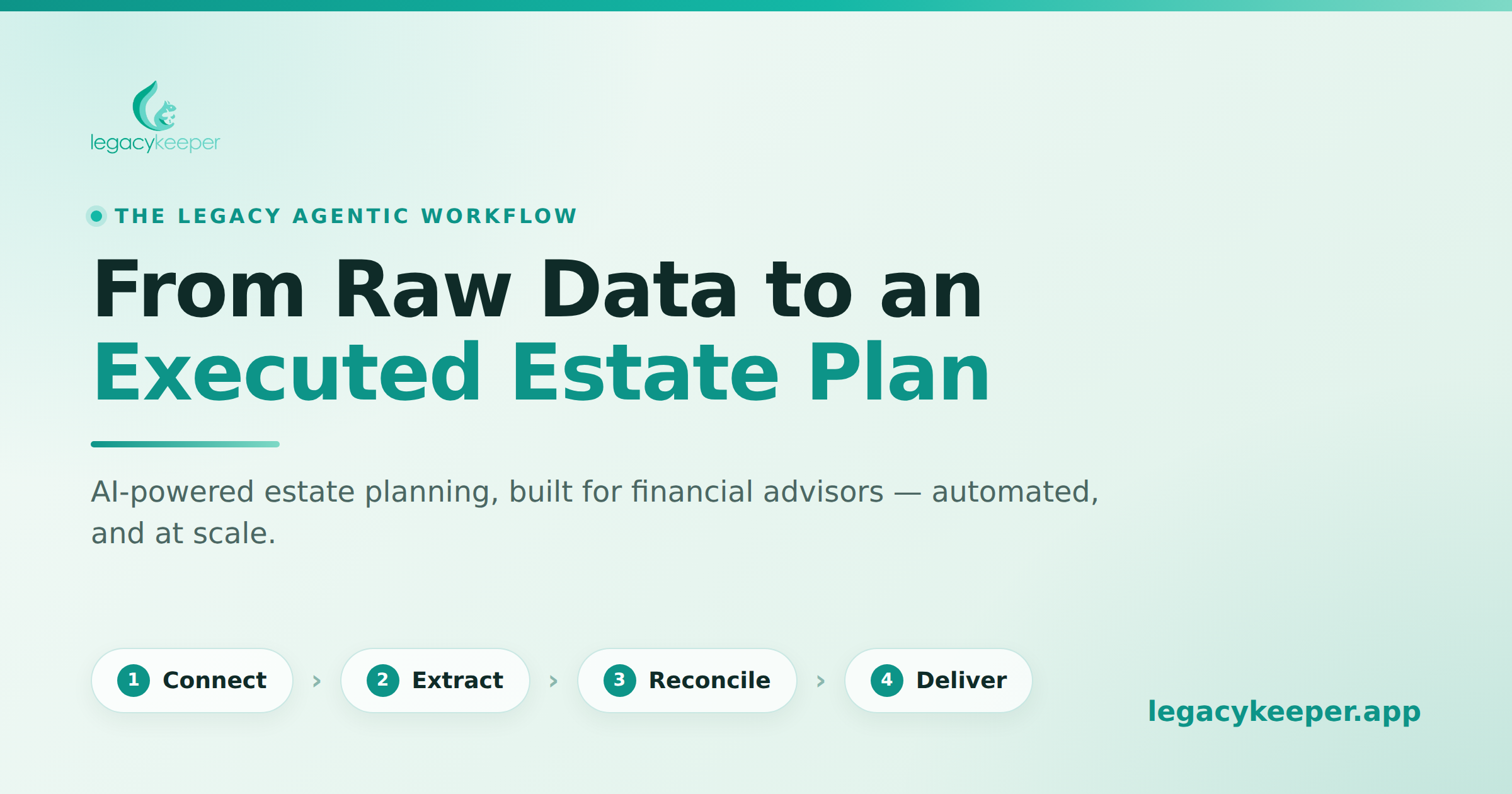
Estate planning workflows help strengthen client relationships. Traditional workflows, however, waste time. Gathering wills, reconciling beneficiaries, and finding tax and probate risks requires hours per household. This limits how many clients advisors can serve.
Step 1: Centralize Data and Automate Classification
Consolidate all client records, documents, and assets in one secure workspace. The system parses each document automatically. It extracts contacts, asset values, beneficiary designations, and ownership details. This eliminates manual sorting and classification.
Advisors do not sort files manually. The platform organizes wills, trusts, insurance policies, and business documents automatically. It transforms unstructured PDFs into usable data. The system scales for all clients, so data entry does not limit growth. Advisors can assess estate scores in minutes.
Step 2: Automate Data Extraction and Score Estate Readiness
This step saves time. AI scans and extracts estate details, reducing manual review from hours to minutes. The platform gives each client an estate readiness score. Advisors see plan completeness and immediate next steps on an automated checklist.
Step 3: Reconcile Data and Generate Reports
The platform verifies all data before analysis. It reconciles extracted information with manually entered records. The system flags discrepancies and aligns ownership and beneficiary details. This process uncovers mismatched forms and wills, creating a solid foundation for analysis.
Specialized AI agents generate clear, actionable reports for wills, insurance, trusts, taxes, probate, and business interests. Each report highlights gaps, risks, and recommendations. Interactive dashboards and family trees present the estate visually. Advisors review these with an AI assistant for deep client insights—no need to hire more staff.
Step 4: Deliver Outputs and Streamline Execution
The final step creates client-ready deliverables. Advisors export white-labeled presentations and PDF summaries for meetings. The platform hands off execution to estate attorneys and tax specialists in the same secure environment. This ensures efficient plan completion.
Clients keep access to their estate plans and collaboration tools, even if their advisor leaves. The estate plan remains a lasting asset for the client relationship—not just a one-time deliverable.
Why the agentic workflow matters for advisors
Each step removes bottlenecks. Advisors deliver estate planning efficiently and at scale. Automated data classification speeds onboarding. Extraction reduces manual entry. Reconciliation and reporting deepen analysis. Seamless deliverables and professional handoff finish the process. Advisors serve all clients with thorough estate plans—without changing their workflow.
Frequently asked questions
What is Legacy Keeper’s agentic workflow? It is an end-to-end estate planning pipeline that connects client data, extracts details from documents, reconciles the estate, generates reports, and produces client-ready outputs, automating the manual steps between raw data and a finished plan.
How much time does it save financial advisors? Legacy Keeper reports that a review that once took roughly half a day per household can be completed in about 20 to 30 minutes.
What reports does the platform generate? Specialized agents produce reports across areas such as Will, Insurance, Trust, Tax, Probate, and Business, each flagging gaps and recommending follow-up steps.
Do clients keep access to their estate plan? Yes. Client data storage and collaboration tools remain available even if the advisor cancels their subscription.
Estate planning, built for financial advisors. See it in action at legacykeeper. app. Estate planning designed for financial advisors. See the platform in action at legacykeeper.app.
Leave a Reply