
You don’t need a big budget or a team of data engineers to use AI Agents For Financial Advisors. Most firms already have the right Microsoft tools. Even a small independent RIA can set up AI-powered workflows in weeks. Start with AI Agents For Financial Advisors without spending much.
Use our product glossary at the bottom of this article for reference.
There Is No One-Size-Fits-All Blueprint
Every firm uses a unique mix of tools. Your CRM, custodian, and planning software may differ. Use this guide as adaptable ideas, not strict instructions.
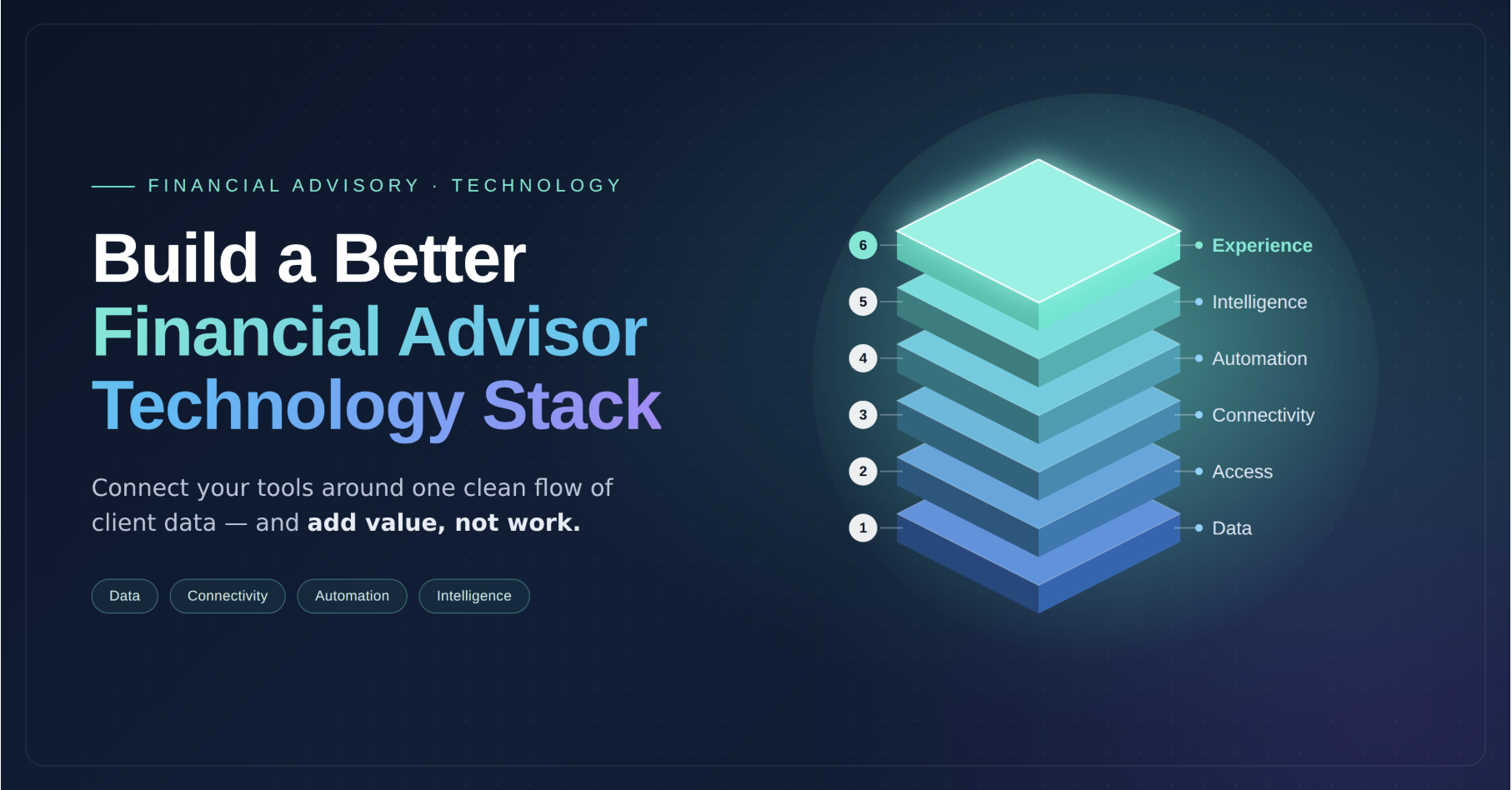
The four-layer approach below covers data, connectivity, intelligence, and experience. It works whether you use Wealthbox, Redtail, Schwab, Fidelity, eMoney, or RightCapital. The specific products may change, but the overall structure stays the same.
AI Agent Workflow Activities
Here is a list of activities that AI agents can support and automate using workflows.
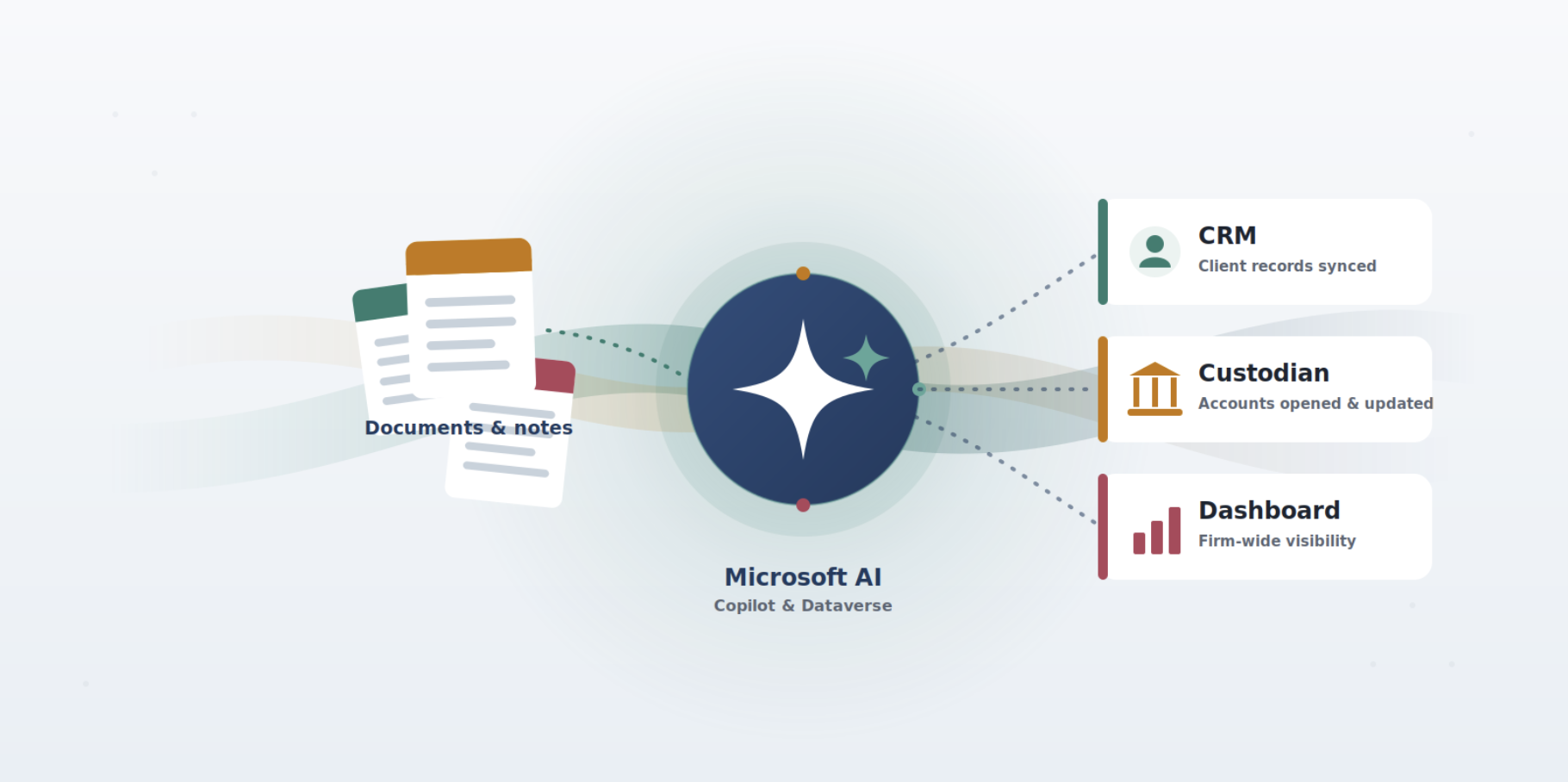
Capture the input. A client meeting, email, or document arrives. Copilot transcribes and summarizes the meeting.
Extract the data. An AI agent reads the onboarding documents and pulls the structured fields, such as name, date of birth, ID, and beneficiaries.
Fill the system. Power Automate writes the reviewed data to Dataverse as a single trusted record, so no one retypes it.
Send to the custodian. A connector submits the data to open or update the account, with a human sign-off on anything irreversible.
Update the CRM. The same record syncs to your CRM, or Dataverse itself acts as your lightweight CRM.
Add notes and tasks. Copilot drafts call and meeting notes, then creates assigned follow-up tasks with due dates.
Pull product data. Scheduled flows bring in trading, insurance, and financial product data from custodians and carriers.
Add held-away assets. Capture outside accounts, real estate, and private holdings.
See everything. A Power BI dashboard shows each client’s status across every responsibility.
The Challenge: What Broken Workflows Cost Your Firm
Small advisory firms lose time and money to redundant processes and bottlenecks. You enter data in the onboarding form, then again in the CRM, custodian portal, and planning tools. As your client list grows, manual work increases. This limits firm growth and raises the risk of errors with sensitive data. Every hour on tedious tasks is an hour not spent advising clients.
The Solution: Automation Creates Capacity
Look at the problem differently, and you’ll spot the opportunity. Most tasks follow a pattern: information arrives, moves between systems, and gets updated. If you automate this, you can eliminate about 80% of repetitive work. Automation gives your team more capacity. You serve more clients, keep organized records, improve data accuracy, and miss fewer items.
Start Here: Map Your Current Workflows First
This is the most important first step, but most firms overlook it.
Before you look at any Microsoft products, map out how your firm operates right now. List every system you use—your CRM, custodian, planning tool, e-signature app, spreadsheets. etc. Then track how client information moves through each step, from the first meeting to a funded account.
Note where your team enters the same data twice, where handoffs slow progress, and where things get missed. Target these bottlenecks for automation. Leave the rest for later.
Don’t rebuild your technology stack until you know what you have and where the problems are. If you automate a process you don’t fully understand, you make mistakes happen faster. You could also waste money on tools that don’t fix the real issues.
Find the Bottlenecks and Problem Systems
Tools like Power Automate guide this process. Discover, task mining, and process mining features map your processes. Microsoft breaks the process into three stages: Discover, Automate, and Orchestrate.
Built-in recommendations show you the best opportunities. Copilot in Power Automate can draft a workflow when you describe it in plain language. Mining finds and ranks the targets, Copilot builds them, and monitoring shows the results. Then the process repeats.
There’s one thing to keep in mind for small firms: full process and task mining is part of Power Automate’s premium, paid tier. It’s best for finding patterns in large volumes of data, so it only pays off if you have lots of cases. If you only do a few onboarding sessions each week, a whiteboard and a stopwatch can give you similar insights. Start by measuring your real process. Only invest in mining tools when you truly need them.
What AI Agents For Financial Advisors Can Automate
AI Agents for Financial Advisors can automate more than you might expect. By using Microsoft, your team can already automate meeting notes, onboarding data extraction, CRM syncing, follow-up tasks, and tracking held-away assets. Leveraging AI Agents for Financial Advisors enables scalable workflow automation and increases advisory firm capacity.
Here’s an example: Copilot summarizes a Teams meeting. Power Automate saves the summary in Dataverse, and a person reviews it before anything is finalized.
Microsoft Dataverse is a secure cloud database service within the Microsoft Power Platform. Instead of storing loose files or spreadsheets, it keeps your information in structured tables (like Clients, Accounts, and Tasks) with defined relationships between them, so one client can link to their accounts, which link to their holdings.
Once you have clean data flowing, you can build a firm-wide dashboard.
Document Storage & Automation
You can start by using data already found in documents. Client documents are stored in a repository like SharePoint, while Dataverse holds each client’s structured record and maintains the association linking that client to their files.
Through Dataverse’s built-in document management, every client record automatically links to its documents, so the data and source files stay tied together in one place. Automation tools like Power Automate and Copilot agents then use those Dataverse connections to open the right document, extract or update data, and push it to the CRM or custodian without anyone re-keying it.
Automate Data Entry
Azure AI Document Intelligence handles general document reading. It comes with prebuilt models that can detect government IDs and U.S. tax forms, such as W-2s, 1099s, and 1040s with schedules. It returns clean, structured data fields. Power Automate with AI Builder moves these fields into Dataverse. For messier, non-standard documents, a Copilot Studio agent can handle the reading.
Wealth-specific extractors can be even better for certain tasks. Holistiplan reads tax returns. Estate and business documents are the hardest for any tool to process because they are long and unstructured. A document classification and estate data extraction tool like Legacy Keeper extracts data and makes it usable for both you and your client. It covers wills, insurance, trusts, corporate, bylaws, agreements, financial plans, retirement plans, and tax plans.
The best data entry is no data entry. Organize your intake process in a step-by-step order. First, link accounts once through an aggregator such as Plaid, Yodlee, or Morningstar. Balances then flow automatically for investment accounts.
Automate Follow Ups
Once Copilot extracts fields from a document or meeting note, the data is stored in Dataverse as structured records, such as renewal dates, deadlines, and action items. Power Automate then watches those records and turns each one into an assigned task in Planner or To Do, a reminder in the Outlook calendar, or an alert in Teams.
Copilot Studio agents scan the records on a schedule to flag anything overdue or upcoming, and Copilot drafts the follow-up email for the advisor to review and send. You can also ask your Copilot agent questions about your clients’ data. Your Power BI dashboard rolls it all up, showing every open follow-up and flagging overdue items across all clients.
The Hard Part: Custodians and Outside Technology
Here’s the main limitation: you control everything inside Microsoft and your CRM, but you don’t control the custodian.
The one unpredictable step is sending data to your custodian to open or update accounts. This depends on what your custodian allows. By 2026, data syncing will be well developed. Aggregators like Morningstar ByAllAccounts or BridgeFT can reliably pull positions and transactions.
Opening accounts through an API is a newer feature and isn’t consistent everywhere. So, start by automating the eight workflows you can control. For the custodian, use an existing connector through your CRM or let Copilot pre-fill the forms for a quick review. Don’t let the custodian step slow down the rest of your automation.
Risks and Compliance You Cannot Skip.
You work with regulated client data, so set up safeguards from the start. Most of these are simple settings, not big projects.
Set up role-specific access in Dataverse so advisors only see their own clients. Always require human approval for anything that can’t be undone, such as opening an account or sending a client personal information.
Enable audit logging and Data Loss Prevention policies. Check your record-keeping rules with your compliance officer before automating anything that moves personal data. You may need Microsoft Purview for unchangeable data retention.
Timelines, Resources, and Real Costs
Expect to spend about 6 to 10 weeks working on this part-time. You’ll see a clear win—like meetings that summarize themselves—within the first two weeks. Be realistic with your budget. Microsoft 365 Copilot costs about $30 per user each month, or $21 per user for Copilot Business if you have fewer than 300 users. You only need to license the two to four people who handle meetings and onboarding.
Add Power Apps Premium for about $20 per user for anyone who uses the client-records app. Add Power BI Pro for dashboards at about $14 per user. You’ll also need Copilot Studio credits for automated triggers. Your ongoing monthly cost is between $250 and $450. This is more than some sales pitches suggest. Plan to hire a part-time Power Platform consultant for a few days during each phase, not just a few hours.
Getting Professionals
Standing up Dataverse and Power BI is not a pure do-it-yourself effort, so most firms bring in a part-time Power Platform consultant to design the core tables, relationships, and security roles and to build the first dashboards correctly. Plan for a few consultant days per phase rather than a few hours, which realistically puts a full build somewhere in the $8,000 to $30,000 range, depending on complexity, on top of recurring monthly costs.
The harder challenges show up in table design decisions, data quality, and governance across development and production environments, all of which need an internal owner who understands the firm’s processes. Do the math and make sure that the time and capital investment makes sense for your team and your goals.
Don’t build a data lake first; start lean.
Start with Dataverse as your foundation. It handles eight of the nine workflows from the start. The full Azure data lake pairs Microsoft Fabric with OneLake and starts around $262 per month. Treat it as Phase 5. Add it only when firm-wide analytics genuinely demand it.
Firms that build the data lake first often spend six figures before automating even one meeting note. Start with the basics, like a digital filing cabinet, and only add the data warehouse when you have enough data to analyze.
Microsoft Product Glossary
Microsoft 365 — The base productivity suite (Teams, Outlook, Word, Excel) that most firms already run and that the whole automation stack builds on.
Dataverse — A secure, structured cloud database that stores your client records as one trusted source of truth and serves as the data foundation.
Power Platform — The umbrella family (Dataverse, Power Automate, Power Apps, Power BI, Copilot Studio) that provides the low-code building blocks for the automations.
Power Automate — The connectivity layer that moves data between apps using 1,000+ ready-made connectors and runs “when X happens, do Y” flows.
AI Builder — The add-on inside Power Automate that reads documents and extracts fields into Dataverse without custom code.
Process Mining and Task Mining — Power Automate’s “Discover” capability that reconstructs your real workflows from system logs and screen recordings to reveal bottlenecks before you automate.
Microsoft 365 Copilot — The AI assistant embedded in Teams, Outlook, Word, and Excel that summarizes meetings, drafts content, and answers questions from your data.
Copilot Studio — The low-code studio where you build custom AI agents that follow your instructions, read your data, and take actions like updating records.
Microsoft Teams — The meetings and calls hub where Copilot captures and summarizes client conversations.
Outlook — The email and calendar app that feeds client communications and follow-ups into the automation flows.
Power Apps — The tool for building simple screens, such as an onboarding review form or a lightweight CRM interface, on top of Dataverse.
Power BI — The dashboard tool that gives you firm-wide visibility into every client’s status across all planning responsibilities.
SharePoint & OneDrive — Stores the actual client files in libraries that link to Dataverse records, while OneDrive handles individual file storage and sharing.
Azure AI Document Intelligence — Microsoft’s OCR and AI extraction service with prebuilt models for government IDs and U.S. tax forms.
Microsoft Fabric — The full analytics platform, treated as an optional later phase, that powers firm-wide analytics at scale.
OneLake — Fabric’s single built-in storage layer, the actual “data lake,” that you add only once your analytics needs outgrow Dataverse.
Microsoft Purview — The governance and compliance tool that handles immutable, records-keeping-grade data retention when regulations require it.
Frequently Asked Questions
Do AI Agents For Financial Advisors need a data lake? No. Dataverse handles the structured client records that power almost every workflow for AI Agents For Financial Advisors. Add a Fabric or OneLake data lake later, and only for large-scale analytics.
What is the actual first step? Map your current workflows and systems end-to-end. Until you know where the bottlenecks sit, rebuilding your tech stack solves the wrong problems.
Can this work without a CRM? Yes. A model-driven Power App on Dataverse gives you a CRM-style interface with no separate CRM fee. If you keep your existing CRM, the automations sync to it.
Which document adds the most value at intake? The prior tax return. One document pre-populates income, dependents, held-away accounts, and planning opportunities at once.
Are there any CRMs that are great for connectivity? Yes, WealthBox has built strong integrations and APIs that can be connected across wealthtech platforms.
References
- Microsoft 365 Copilot & Copilot Studio pricing — CloudZero
https://www.cloudzero.com/blog/copilot-studio-pricing/ - Copilot Studio licensing and internal-use rights — Samexpert
https://samexpert.com/copilot-studio-licensing-guide/ - Power Platform / Dataverse premium licensing — Redress Compliance
https://redresscompliance.com/microsoft-power-platform-licensing-deep-dive - Power Platform licensing FAQ — Microsoft Learn
https://learn.microsoft.com/en-us/power-platform/admin/powerapps-flow-licensing-faq - Dataverse capacity & storage pricing — Microsoft Negotiations
https://microsoftnegotiations.com/blog/dataverse-capacity-licensing - Schwab automated onboarding API (early access) — Dispatch
https://dispatch.io/blog/dispatch-account-opening-with-schwab-apis - Process & task mining — Power Automate Process Mining, Microsoft Learn
https://learn.microsoft.com/en-us/power-automate/process-advisor-overview - Document extraction — Azure AI Document Intelligence (US tax & ID prebuilt models), Microsoft Learn
Tax models: https://learn.microsoft.com/en-us/azure/ai-services/document-intelligence/prebuilt/tax-document
ID models: https://learn.microsoft.com/en-us/azure/ai-services/document-intelligence/prebuilt/id-document - Wealth-specific extraction — Holistiplan, FP Alpha (Kitces AdvisorTech)
Holistiplan: https://www.holistiplan.com/
FP Alpha: https://fpalpha.com/
Kitces AdvisorTech: https://www.kitces.com/advisortech/ - Digital intake with CRM sync — PreciseFP + Wealthbox
PreciseFP: https://precisefp.com/
PreciseFP + Wealthbox: https://precisefp.com/partners/wealthbox/ - Estate & business document management and classification — Legacy Keeper
https://legacykeeper.app/ - Account data aggregation — Morningstar ByAllAccounts, Plaid, Yodlee
Morningstar ByAllAccounts: https://www.morningstar.com/business/products/byallaccounts/for-enterprises
Plaid: https://plaid.com/
Yodlee: https://www.yodlee.com/ - WealthTech API for custodial data — BridgeFT (Schwab Advisor Services)
https://www.bridgeft.com/wealthtech-api/ - CRM integrations — Wealthbox, Redtail (Orion), Salesforce Financial Services Cloud
Wealthbox: https://www.wealthbox.com/
Redtail (Orion): https://redtailtechnology.com/
Salesforce Financial Services Cloud: https://www.salesforce.com/financial-services/cloud/ - Planning-tool connectivity — eMoney Advisor, Envestnet MoneyGuide, RightCapital, Asset-Map
eMoney Advisor: https://emoneyadvisor.com/
Envestnet MoneyGuide: https://www.envestnet.com/financial-planning
RightCapital: https://www.rightcapital.com/
Asset-Map: https://www.asset-map.com/
Educational only. This article is not legal, compliance, tax, or investment advice. Confirm live Microsoft and vendor pricing for your region and agreement before you build.

Leave a Reply